
In some Korean paintings, fish swim and birds fly inside letters! These paintings are called munjado, or “letter pictures.”
The letter chung (忠, loyalty) is a good place to start. It often holds a shrimp: painters saw the shrimp’s hard shell as a tiny suit of armor, a sign of someone whose principles cannot be bent. Bamboo is often drawn close by, because a stalk may snap but never bend — like the unbending integrity of a loyal subject. And since the words for shrimp (ha, 蝦) and clam (hap, 蛤) sound like the word for harmony (和合), these letters also carried a quiet wish: that ruler and ministers would work together in harmony and keep the land well ordered.
Eight good values
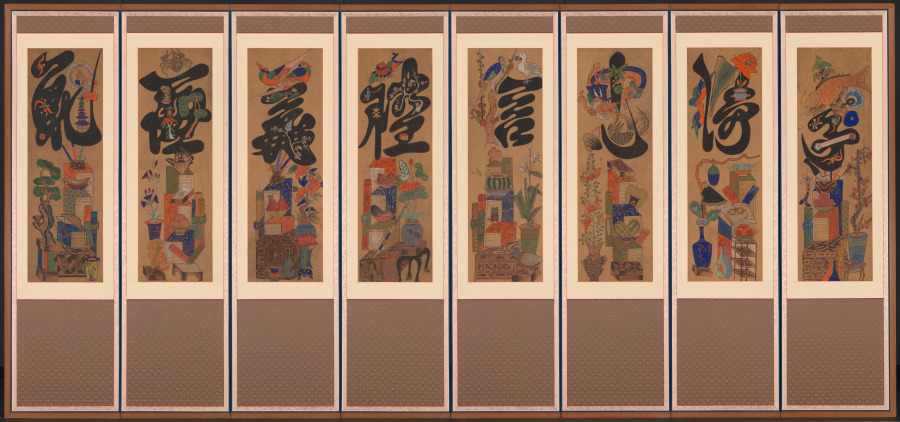
Munjado usually show eight Chinese characters. Each one names a value people hoped to live by:
- Hyo (孝) — love and respect for parents
- Je (悌) — kindness between brothers and sisters
- Chung (忠) — loyalty and a true heart
- Sin (信) — trust
- Ye (禮) — good manners
- Ui (義) — doing what is right
- Yeom (廉) — honesty, not being greedy
- Chi (恥) — knowing shame, a clean conscience
A picture puzzle
Inside each letter, painters added animals and plants that tell a story about that value. For example, the letter yeom (廉, honesty) often includes a crab. You don’t need to read Chinese to enjoy these paintings — you can read them like a puzzle.
The second screen on this page mixes letters with bookshelves. It is a fun mix of two kinds of minhwa: munjado and chaekgeori.
From the Artist
— Jieun Ro
Of the eight letters, I like Chung (忠) best, and I would love to paint it myself.
People often think of Chung as grand loyalty to a country or a king. But look at how the character is built: it is “middle” (中) on top of “heart” (心). To me, it means a true heart that keeps its center without leaning to one side — the steady care I give to my work and to the people beside me.
The shapes are exciting too. Lively symbols such as a carp swimming up a rough waterfall to become a dragon, a sacred dragon, and clear little shrimp often appear with Chung. Under the heavy, upright letter, books and lively images come together beautifully. I want to capture that energy and care with the tip of my brush.
Try This
Pick one of the eight values. Which animal or object would you hide inside that letter, and why?
Image credits & sources
- The Character “Chung” (忠) from a Munjado set, 1851–1900 — Brooklyn Museum, 77.97.4 · No known copyright restrictions
- Munja-Chaekgeori (letters and books), eight-panel folding screen, early 1900s — Cleveland Museum of Art, 2017.6 · CC0
- Seo Seong & Kang Hee-an (2022), “A Study on the Theme of the ‘Crab’ Yeom-ja-do,” Korean Studies 64 (Korean, PDF)
- Brooklyn Museum 77.97.4 (Wikimedia Commons)
This story is part of an ongoing series. More stories are on the way.
Back to all stories