
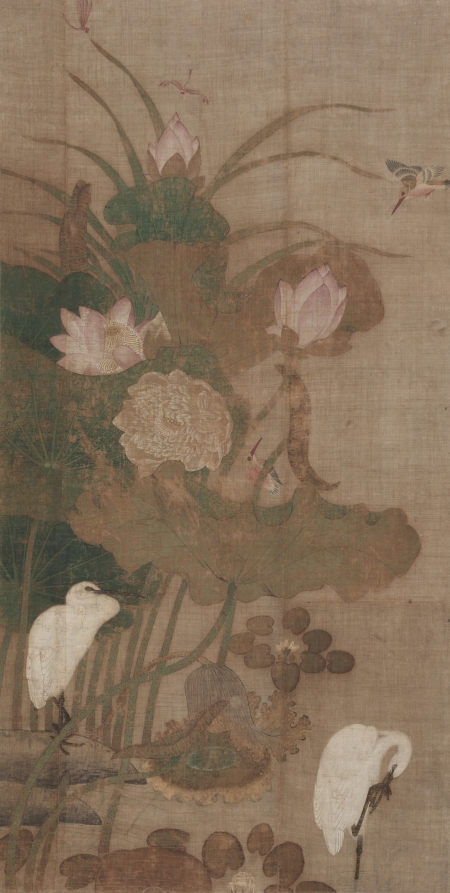
Try counting the birds in a minhwa painting. Very often you will find two — or a whole flock. A bird painted all alone is rare.
These paintings are called hwajodo, “bird-and-flower paintings.” They were some of the most loved minhwa, and they often decorated happy family events.

Hidden messages
Painters did not pair birds and flowers just because they looked pretty. They chose each one for its meaning. Sometimes the meaning even came from a play on words.
For example, one egret with a lotus seed pod makes a wish called illo-yeongwa: “Pass the big exams, one after another, all the way.” In Chinese characters, “one egret” sounds like “one road,” and “lotus seed” sounds like “passing exams in a row.”
The paintings on this page show lotuses, insects, and birds, and a ten-panel screen of birds and flowers. As you look, ask: what blessing might this pair be sending?
From the Artist
— Jieun Ro
Minhwa has so many subjects that there are still many pictures I have not yet painted. Among them, bird-and-flower painting is especially loved. Our ancestors did not pair flowers and birds at random. They wove together each one’s nature and its lucky meaning. Here are a few favorite pairs:
Lotus with an egret or mandarin ducks: An egret with a lotus seed pod wishes for passing the state exams in a row — a sign of success. Mandarin ducks under a lotus, which blooms clean even from the mud, wish for lasting love between husband and wife and a happy home.
Peony with a peacock or golden pheasant: The peony, king of flowers, means wealth and honor. The peacock stands for high rank and nobility. Together they fill the picture with wealth and honor — a grand, court-style pair.
Plum blossom with sparrows or magpies: The plum blooms first, breaking through the cold, and means spring and a strong spirit. Sparrows and magpies bring good news. Birds singing on an early-spring plum branch wish, “May happy news fly into this home with the new spring.”
In bird-and-flower painting, not a single flower or bird is there by chance. Each pair is chosen for the blessing it sends — that is its great charm. Since there are still so many I have not painted, learning these meanings one by one as I color is an endless joy.
Try This
Design your own pair: choose one flower and one bird, and decide what blessing they send together.
Image credits & sources
- Lotuses, Insects, and Birds, 1800s — Cleveland Museum of Art, 1985.18 · CC0
- Birds and Flowers, ten-panel folding screen, late 1800s — The Metropolitan Museum of Art, 1993.255 · Public domain
- Academy of Korean Studies Digital Humanities wiki, “일로연과” (Korean)
- Incheon Metropolitan City Museum, “화조도” object page (Korean)
This story is part of an ongoing series. More stories are on the way.
Back to all stories